
Average siding installation cost depends entirely on the material. Vinyl starts at $0.70 to $1.00 per square foot. Hardie board runs $1.00 to $1.20 per square foot, but painting adds roughly $0.30, bringing the real number to about $1.50. Hybrid PVC composite matches Hardie on price with no painting required. Premium products range from $1.50 to $2.50 per square foot.
The question sounds simple. What does siding cost? But the honest answer is: it depends on what material you’re putting on the wall. The range across the four main categories is wide enough that “average siding cost” isn’t a single number. A vinyl siding price and a premium composite price are completely different conversations, and choosing without understanding why can lead to a decision that costs more in the long run than a slightly higher starting point would have.
“The lowest on the lower end would be vinyl siding. It will cost somewhere between $0.70 and $1 per square foot.”
Vinyl is the starting point of the siding cost conversation. It’s the most widely installed siding material on residential homes in the United States, and the price reflects its position as the accessible entry point into the category.
That $0.70 to $1.00 range covers the material and standard installation labor. It’s not a stripped-down budget number, it’s what a typical residential vinyl siding installation actually costs per square foot on a straightforward project. Multiply that by the total square footage of the home’s wall surfaces and you have a working ballpark for a vinyl re-siding job.
What the number doesn’t include is any wall assembly work that might be needed once the existing siding comes off: vapor barrier replacement, damaged sheathing, window flashing corrections. Those are scope additions that show up on any material, not just vinyl, and they’re part of why on-site assessment matters before any estimate is finalized.
And it’s worth saying plainly: vinyl is the cheapest option because it’s the least durable option in Florida’s specific climate conditions. It warps in extreme heat, fades under UV exposure, and cracks with temperature swings. A $0.70 per square foot number looks good on day one. How it looks in year ten depends on the weather and how much maintenance has been done in between.
For a direct comparison of how vinyl siding performs against fiber cement over time in Florida’s climate, including maintenance costs and lifespan, see our breakdown of vinyl versus Hardie fiber cement for Florida homeowners.
“Next level up would be Hardie siding. It will cost about $1 to $1.20 a square foot. But also you have to remember to add the cost of painting.”
That last sentence is the important part. And it’s the detail that most price comparisons leave out.
Hardie board, James Hardie fiber cement, a cement-based exterior cladding engineered for moisture resistance and dimensional stability in Florida’s climate, costs $1.00 to $1.20 per square foot for material and installation labor. That number is real. But it’s not the full number unless the siding comes with a factory-applied finish already on it.
Field-painted Hardie siding requires painting after installation. That’s not optional, raw fiber cement needs a protective paint coat to perform correctly and to look right. Add painting cost and the total runs to approximately $1.50 per square foot. Ivan states this directly: “After you paint Hardie siding, it should cost about $1.50 a square foot.”
So when comparing Hardie to vinyl on price, the honest comparison is $1.50 all-in versus $0.70 to $1.00. Not $1.00 versus $0.70. The gap is real, and it’s worth understanding clearly before making a material decision based on installation price alone.
The case for Hardie at $1.50 is strong. It doesn’t warp in heat. It doesn’t rot. It resists termites. A properly applied factory ColorPlus finish lasts 10 to 15-plus years without repainting, reducing the maintenance cycle significantly compared to field-painted alternatives. Over a 15 to 20-year ownership window, that maintenance cost difference changes the total cost calculation meaningfully.
But the painting cost is part of the upfront number. That’s what the $1.50 figure captures, and it’s the number to work with when building a realistic siding budget for fiber cement.
“Another option is a next-generation hybrid PVC composite. A good example of that siding is Ascend. This siding has the same cost as Hardie siding, but you don’t have to maintain and paint that siding.”
This is the tier that changes the cost conversation the most, and it’s the one homeowners are least likely to have heard of before starting the estimate process.
Hybrid PVC composite siding, products like Ascend, sit in the same price range as Hardie fiber cement on a per-square-foot basis. The installation cost is comparable. But the ongoing cost is different, because these products come with a factory finish that doesn’t require repainting on the same cycle as field-painted fiber cement.
No painting after installation. No maintenance repainting on a 5 to 7-year cycle. The color is part of the material, not a coating applied on top of it.
So the math looks like this. Hardie with field painting: $1.50 per square foot upfront, plus repainting costs over time. Hybrid PVC composite: similar installation cost, lower ongoing maintenance cost. Over a long ownership window, the total cost comparison between these two materials is tighter than the installation price alone suggests, and in some cases, the hybrid composite comes out ahead when maintenance is fully accounted for.
RIA Construction has been installing both fiber cement and hybrid PVC composite products on Tampa Bay residential projects. The right choice between them depends on the homeowner’s budget, aesthetic preferences, and how they’re thinking about maintenance over the years they plan to own the home. Neither is universally the right answer. Both are significantly better long-term options than vinyl in Florida’s climate.
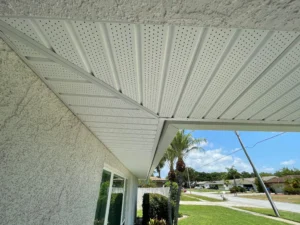
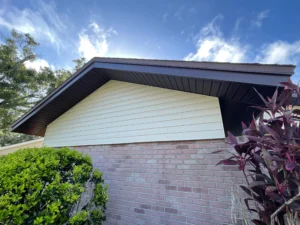
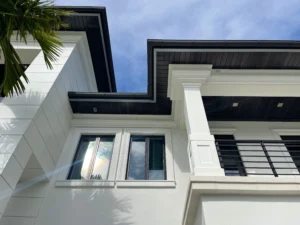
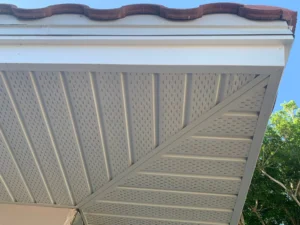
“On the higher end, we can talk about products like Exceed or Everlast. It will cost you between $1.50 to maybe $2.50 depending on the design of the siding.”
The premium tier covers products that combine advanced material performance with more architectural design options than standard fiber cement or PVC composite profiles offer. Exceed and Everlast are both engineered for high durability with factory finishes designed to hold color for extended periods in demanding climates.
The $1.50 to $2.50 range is wide because the design variable matters significantly in this tier. A straightforward horizontal lap profile in a premium material runs closer to the lower end. More complex profiles, board and batten, wide panel, or configurations with multiple accent treatments, push the price toward the upper end of the range because they require more individual pieces, more cuts, and more installation time per square foot.
That’s worth understanding before selecting a profile from a catalog. The material tier establishes a price range. The specific design you choose within that tier positions you within that range. A premium material in a simple profile may cost the same as a mid-tier material in a complex profile. Those two decisions should be made together, not separately.
For homeowners whose primary goal is the longest possible lifespan with the least maintenance, the premium tier is where that conversation starts. The upfront cost is higher. The long-term performance and appearance retention are at the top of what residential siding products currently offer.
For a practical overview of how siding profiles and design choices affect installation cost, and what to expect from a Hardie or composite estimate, see our guide to what actually affects siding installation prices on Florida homes.
“The right choice isn’t always the cheapest one. It’s the one that fits your home, your climate, and your long-term budget.”
That framing is the right way to approach siding cost in Florida. And it’s a genuinely different way to think about it than most homeowners start with.
Most homeowners begin with the installation price per square foot, multiply it by the square footage of their home, and use that as the comparison number. That’s a reasonable starting point. But it’s incomplete, because it only captures day-one cost. It doesn’t capture what happens to that number over the next 10 or 15 years.
Vinyl at $0.70 to $1.00 per square foot is the cheapest installation. But vinyl fades, warps, and cracks in Florida’s conditions. A home with vinyl siding that’s 10 years old in Tampa Bay has almost certainly required some maintenance, faded sections repainted, warped panels replaced, caulking around windows redone. Those costs are real. They just don’t appear on the original estimate.
Hardie at $1.50 all-in costs more upfront. But the factory finish lasts 10 to 15-plus years without repainting, the material doesn’t warp in heat, and termite resistance is a genuine benefit in Florida specifically. The maintenance bill over a 15-year period is lower. Whether the total cost of ownership over that window favors Hardie depends on the specific home and usage, but the directional case is consistent.
Hybrid PVC composite at roughly the same upfront cost as Hardie, with no painting maintenance requirement, changes the long-term calculation again. For homeowners who want to make one investment and not think about siding maintenance for as long as possible, the hybrid composite tier deserves serious consideration even though it’s not the most commonly discussed option.
And the premium tier at $1.50 to $2.50 represents the top of both the performance range and the design range. For a homeowner who wants the best available product for a long-term Florida residence, that’s where the conversation goes.
None of these answers is right for everyone. But the right framework is always: what does this choice cost me over the full period I’m going to own this house, not just on the day the crew finishes.
Vinyl siding installation costs between $0.70 and $1.00 per square foot, covering material and standard labor on a typical residential project. That range applies to a straightforward re-siding job where the wall assembly behind the existing siding is in good condition. If damaged sheathing, missing vapor barrier, or window flashing corrections are needed after the old siding is removed, those are additional costs that can’t be confirmed until the wall is opened up.
Hardie board installation is typically quoted at $1.00 to $1.20 per square foot for material and labor, but that number does not include painting. Field-painted fiber cement requires a protective paint coat after installation, which adds approximately $0.30 per square foot, bringing the realistic all-in cost to around $1.50 per square foot. Some Hardie products come with a factory ColorPlus finish already applied, which eliminates the field painting step and the associated cost, that detail is worth clarifying when comparing estimates.
Hybrid PVC composite siding is a next-generation exterior cladding product, examples include Ascend, that combines the performance of engineered materials with a factory finish that requires no painting or ongoing maintenance. Installation cost is comparable to Hardie fiber cement on a per-square-foot basis, but without the painting cost that Hardie field installations carry. For homeowners who want fiber cement-level durability without the maintenance cycle of repainting, hybrid PVC composite is worth including in the material comparison.
Premium engineered siding products in the Exceed and Everlast category run $1.50 to $2.50 per square foot installed, with the specific price depending on the design profile selected. Simpler horizontal lap profiles land closer to the lower end of that range. More complex profiles, board and batten, wide panel, or multi-accent configurations, push toward the upper end because they require more pieces, more cuts, and more labor per square foot. The $1.50 to $2.50 range is real, and the design choice is a meaningful variable within it.