
For coastal homes in Florida, Sagiper panels on ceilings combined with Hardie board and batten siding on exterior walls is one of the most practical material pairings available. Both are designed to handle salt air, humidity, and storm exposure without the ongoing maintenance cycles that painted or wood-based alternatives demand.
“Great solution for the houses that close to the beach.”
That’s how Ivan from RIA Construction Corp describes this combination on a finished project near Madeira Beach. Simple line. But it comes from working on coastal Tampa Bay homes long enough to know what fails and what doesn’t.
Homes near the Gulf face a specific set of conditions that inland Florida homes don’t deal with at the same intensity. Salt air gets into every surface. Humidity doesn’t dry out between rain events. UV intensity bleaches and degrades finishes faster than almost anywhere else in the country. And storm season brings wind-driven rain that finds every gap and penetration in an exterior system.
Most traditional exterior materials weren’t designed for all of that simultaneously. Wood looks great for a while, then repainting, then rot, then repair. Vinyl holds up better but fades and can’t replicate the architectural character most coastal homeowners want. So what actually works here? That’s the question this project was answering.
The answer is a two-material system. Sagiper for the ceilings. Hardie board and batten for the walls. And it’s worth understanding why each material was chosen for its specific location on the home.
Board and batten is a vertical siding profile: wide flat panels with narrower battens covering the vertical seams. It’s been part of Florida coastal architecture for a long time. The look fits the setting. The problem is that traditionally it was done in wood, and wood board and batten on a home close to the Gulf is a maintenance commitment most homeowners underestimate before they agree to it.
James Hardie fiber cement in a board and batten profile delivers the same clean vertical lines without the wood problems. It’s cement-based, so it doesn’t swell from humidity, doesn’t rot from moisture intrusion, and doesn’t split or crack from the heat cycle that Florida’s climate runs through every single day. Our team uses this product on coastal projects specifically because the material performs where wood fails.
The other thing worth knowing: James Hardie’s ColorPlus factory finish holds color for 10 to 15-plus years under Florida UV without repainting. Compare that to field-painted wood or even field-painted fiber cement, which typically needs attention every five to seven years in this climate. That gap compounds fast over a 20-year ownership window.
And this is where people get it wrong. They see board and batten and assume it’s all the same product. It’s not. The profile is the same. The material performance is completely different. When our team specifies Hardie board and batten for a coastal Florida wall, the material choice is driven by what that wall is going to face for the next 20-plus years, not just how it looks on day one.
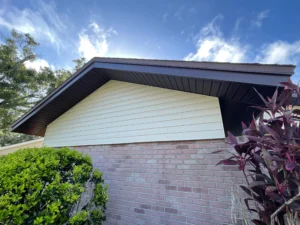
On the Madeira Beach project, the board and batten Hardie panels are doing two things at once: covering the wall surfaces and creating architectural depth through the vertical profile. On mixed-material exteriors where stucco handles the primary field and Hardie handles accent areas, the board and batten profile creates visual interest and breaks up large wall planes without adding complexity to the maintenance picture.
Sometimes it covers the full exterior. Sometimes it’s used selectively on accent elevations or specific architectural features. Either way, the performance logic is the same. Florida coastal conditions, no maintenance for over a decade.
“Sagiper panel on the ceiling.”
That’s the detail Ivan points out first on the finished project. And it’s the one that surprises most homeowners who aren’t familiar with the product.
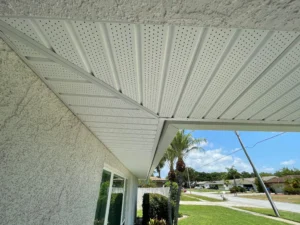
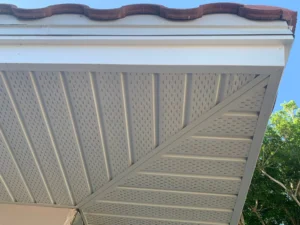
Sagiper is a PVC composite engineered to look like real wood but perform like a synthetic material. Most people see it used for siding or soffit. Using it on ceilings, both exterior and interior, is a different application, and on coastal Florida homes it makes genuine sense.
Think about what exterior ceiling surfaces deal with on a Gulf Coast property. Covered porches, outdoor living areas, roof overhangs: these surfaces face condensation from humidity, rain splash, salt-laden air moving horizontally off the water, and direct sun exposure on south and west-facing elevations. Real wood ceilings in those conditions require repainting on a regular cycle. Once the paint fails, moisture gets in. Once moisture gets in, the wood starts degrading. It’s a predictable sequence.
Sagiper breaks that sequence. It looks like wood, close enough that most people don’t question it at a normal viewing distance, but the PVC composite base doesn’t absorb moisture, doesn’t rot, and doesn’t need a paint cycle. The installation team on this project used it on both the exterior ceiling spaces and the interior ceilings.
And when it’s used on interior ceilings as well, it creates visual continuity between indoor and outdoor living spaces. On a coastal home where that indoor-outdoor connection is part of the lifestyle, the material consistency reads intentionally. Not like a practical substitution. Like a design decision.
Here’s the thing. Sagiper and Hardie aren’t just two good individual choices that happen to show up on the same project. Together, they solve the complete exterior maintenance problem for coastal Florida homes.
The walls, where architectural character and weather resistance matter most, get James Hardie fiber cement. Cement-based, dimensionally stable, factory-finished, decades without repainting.
The ceilings, where moisture, condensation, and outdoor exposure combine in the worst possible way for wood, get Sagiper PVC composite. Looks like wood. Performs like a synthetic. No maintenance.
So what usually happens on coastal homes that weren’t built with this thinking? One surface gets addressed. Another surface creates problems a few years later. A wood soffit starts showing wear while the siding still looks fine. An exterior ceiling needs repainting while the fascia holds up. The maintenance never really ends. It just rotates between surfaces on different timelines.
A whole-system approach is designed to avoid that rotation entirely. Every material chosen for its specific location’s exposure conditions. Every component selected to perform without creating work downstream. That’s the logic behind this combination.
Not every situation requires a full exterior system overhaul. But some indicators point toward it pretty clearly.
Repair still makes sense when:
Full replacement, or a system upgrade, becomes the right conversation when:
Homeowners searching for a siding contractor near them in Sarasota or anywhere along Florida’s Gulf Coast who are dealing with repeated wood exterior maintenance are usually at the point where the system upgrade conversation makes more financial sense than another repair cycle. The math changes when you factor in paint labor, material costs, and the frequency that Florida’s climate demands.
What impacts siding replacement cost in Sarasota and Tampa Bay isn’t just the material. It’s the substrate condition underneath, whether moisture has gotten into wall framing or ceiling structure, and the complexity of the roofline and architectural details. A thorough wall assembly and ceiling structure inspection before confirming any scope is essential: the surface condition and the underlying condition are two different things, and coastal Florida makes that distinction matter more than most places.
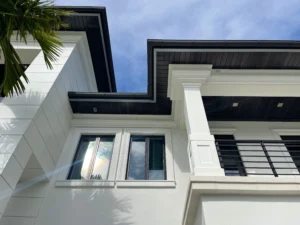
The Madeira Beach project in the video is a block construction home. Both floors. Stucco on the primary wall surfaces. Hardie board and batten as architectural accent panels. Sagiper on exterior ceiling areas and interior ceilings for visual continuity. Aluminum fascia at the roofline.
Every material selected for one reason: the home is close to the beach, and the goal from the start was a maintenance-free exterior system.
And honestly, that’s the difference between choosing products off a spec sheet and choosing products because you’ve watched them hold up, or not, through Florida storm seasons for two decades.
James Hardie fiber cement siding in a board and batten profile is one of the strongest choices for beach homes in Florida. It doesn’t absorb moisture, doesn’t rot, and the factory ColorPlus finish holds color for 10 to 15-plus years without repainting. For homes close to the Gulf, combining cement-based wall cladding with a low-maintenance ceiling system like Sagiper is the approach that produces long-term performance with minimal upkeep.
Sagiper is a PVC composite panel system that mimics the appearance of real wood, used for siding, soffit, and ceiling applications. For outdoor ceiling areas on Florida coastal homes, covered porches, overhangs, and exterior living spaces, it’s an excellent choice because it handles humidity, condensation, and salt air without requiring painting or sealing. It’s particularly well-suited to properties where real wood ceiling maintenance has become a recurring cost problem.
With proper installation and factory ColorPlus finish, James Hardie board and batten siding typically lasts 30 to 50 years structurally and goes 10 to 15-plus years before any repainting is needed in Florida coastal conditions. Compare that to wood board and batten, which typically needs paint attention every 5 to 7 years near the Gulf. The lifespan difference in a salt air environment is substantial enough that the higher upfront cost of Hardie almost always produces lower total ownership cost over a 20-year window.
Yes, and that’s actually one of the reasons it works well on coastal Florida homes with indoor-outdoor living areas. Sagiper performs on both applications, which means you get visual continuity between interior and exterior ceiling spaces using the same material. The result is a cohesive appearance between covered outdoor living areas and adjacent interior spaces, without the maintenance complexity that real wood ceilings would require in either location.