
There is no single best siding option for every home. The right choice depends on your climate, your budget, and honestly – how much maintenance you’re willing to deal with long-term. In Florida, those three factors point in very specific directions, and the products that work well in the Midwest or Northeast don’t always hold up the same way here.
“There is no one best option.”
That’s how Ivan from RIA Construction opens the conversation. And he means it. He’s holding physical samples in the video – not talking about specs off a brochure- and he walks through four products that actually perform in Florida conditions.
So if you’ve been searching for the best siding for Florida homes and getting generic answers, this is more useful. Because the real question isn’t which product wins overall. It’s which product fits your house, your exposure, and what you want from the next 20 years of ownership.
Each material has a different answer to that question.
“You didn’t see the new variations of aluminum siding which you can see – look right here – very nice modern look, good warm feeling.”
Most people still picture old, thin, dented aluminum when they hear aluminum siding. That’s not what this is. The newer Kaycan aluminum profiles have a clean architectural look – Ivan specifically notes using it for accents on a home’s exterior, not necessarily full coverage.
What aluminum does well in Tampa Bay:
Where it’s not always the first choice for full installations – impact resistance and denting can be a consideration in storm-prone areas. But as an accent material, or for the right architectural style, the new aluminum profiles are worth a serious look.
“One of my favorites. It’s called Everlast. The biggest difference between this and let’s say a fiber cement – this siding is water resistant. Which is actually very good in Florida.”
This is the one he calls out specifically. And the reason is practical, not just preference.
Fiber cement is a strong product – but it’s not fully waterproof. It resists moisture, but sustained water contact can eventually cause problems. Everlast is a different category. It’s a composite material designed to be genuinely water resistant, not just moisture resistant.
Ivan explains it directly: “Let’s say if you have a storm, or any water, if something – you have flood – this siding can be like underneath of the water. Nothing’s going to happen with it.”
That’s not a small distinction in Tampa Bay. Storm surge, wind-driven rain, flooding events – these aren’t hypothetical scenarios here. They happen. And siding that can handle being submerged without damage is a meaningful advantage over materials that can’t say the same.
The other thing: no maintenance. No painting. No upkeep cycle.
“You don’t have to maintain, you don’t have to paint, you don’t have to do anything with it.”
For Florida homeowners tired of repainting every 5–7 years – which is the real-world cycle for painted fiber cement under Florida UV – that matters. The paint cycle alone adds up significantly over 20 years of ownership. Everlast removes that cost entirely.
For most Tampa Bay homeowners weighing long-term ownership cost, this is where the comparison gets interesting. The upfront numbers might differ, but factor in zero maintenance over 20 years and Everlast’s total cost of ownership changes the math.
If you want a side-by-side look at how composite siding stacks up against fiber cement for Florida homes, see our full guide to Everlast composite vs. fiber cement siding for Gulf Coast Florida homes – it covers performance, maintenance cycles, and real installation considerations.
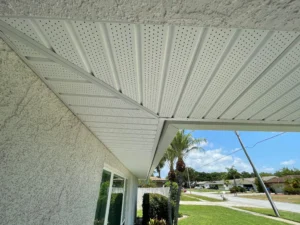
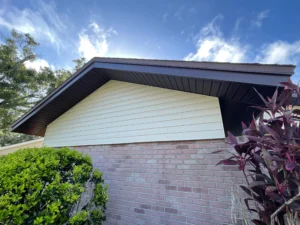
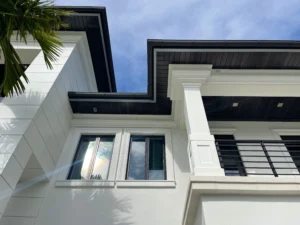
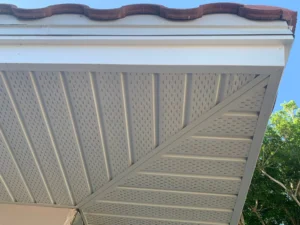
“Newer products that look amazing, I think, and mimic like real wood – is this guy right here. Sagiper. It’s also PVC vinyl, some kind of composite. Looks just like real wood.”
A lot of Tampa Bay homeowners want that natural wood appearance on their exterior. Especially on coastal properties in Clearwater, St. Pete, or along the Gulf – the wood look fits the architecture.
The problem with actual wood siding in Florida is predictable. Humidity. Moisture. Rot. Repainting constantly. It requires more upkeep than most homeowners want to deal with, and in coastal conditions, that maintenance cycle accelerates.
Sagiper solves the visual without the maintenance problem. It’s PVC-based composite – so it gets the look of wood with the moisture resistance of a synthetic material. And Ivan points out something that matters for versatility: “You can do soffit with it, you can do siding.” Same product, multiple applications across the exterior.
So if you want wood-look siding with wood-look soffit that matches – Sagiper handles both. That’s not something you can do with every product.
On homes where the aesthetic matters as much as the performance – and honestly, in Sarasota and Tampa Bay’s residential market, it often does – this is the product that delivers both without forcing a compromise.
The fourth product Ivan mentions in the video is XCEED Systems – exterior solutions built for long-term weather resistance and durability. It rounds out the material range he covers, giving homeowners options across different performance priorities and budget levels.
The pattern across all four products is consistent: each one was selected for Florida-specific conditions. Not because they look good in a showroom – because they hold up in heat, humidity, storm exposure, and the year-round climate conditions that wear out materials faster here than most places in the country.
So how do you actually decide?
It depends. And that’s a real answer, not a dodge.
Here’s how to think through it:
Budget matters too. And the honest reality is that what impacts siding replacement cost in Tampa Bay isn’t just the material you pick – it’s also the condition of the substrate behind the existing siding, the complexity of your roofline and trim details, and whether any moisture damage needs to be addressed before new material goes on.
Anyone searching for siding installation near them in Tampa Bay should factor that into conversations with contractors. A lower material cost doesn’t always mean a lower project cost if the wall assembly underneath needs work first.
For a full breakdown of what drives siding replacement cost in Florida and what to expect at different budget levels, see our guide to siding installation cost in Tampa Bay – what homeowners actually pay and why.
This is where people get it wrong most often: they choose a material based on how it looks in a sample photo, without thinking about what happens to that material five or ten years into a Florida climate.
Wood looks beautiful. Fiber cement looks beautiful. But in Tampa Bay – humidity year-round, storm season every year, UV intensity that’s among the highest in the country – the maintenance that comes with those materials compounds over time. And most homeowners underestimate what that looks like in real dollars over a 15-year ownership window.
The products Ivan is walking through in the video aren’t the most traditional options. They’re the ones that actually make sense for this climate. That’s the difference between a contractor who works in Florida every day and advice that applies generically to any market.
“There is no one best option. The right siding depends on climate, budget, and maintenance expectations.”
That’s the real answer. And in Florida, climate and maintenance expectations point very specifically toward water-resistant, low-maintenance composite systems – especially when you’re planning to stay in the home and want exterior work that doesn’t need to be revisited every few years.
Based on real Florida conditions, Everlast composite siding is one of the strongest low-maintenance options available. It’s fully water resistant – not just moisture resistant – requires no painting, and holds up through direct water exposure including flooding events. For Tampa Bay homeowners who want to install once and not think about it again, that combination is hard to match.
Modern aluminum profiles are genuinely improved from older versions – they have a cleaner, more architectural look and handle Florida humidity well since they don’t absorb moisture. They work best as accent material or on homes with contemporary architecture. For full exterior coverage on a primary residence, composite options tend to offer more versatility, but aluminum is a legitimate choice for the right application.
Sagiper PVC composite is designed specifically for that – it mimics real wood appearance closely enough that most people can’t tell the difference from a normal viewing distance, but it’s PVC-based so moisture, rot, and repainting aren’t concerns. It works for both siding and soffit, which means you can match the material across the full exterior without using actual wood anywhere.
The main practical difference is water resistance and maintenance. Fiber cement resists moisture but isn’t waterproof and needs repainting on a roughly 5–10 year cycle under Florida UV conditions. Everlast is fully water resistant and maintenance-free. If your priority is the lowest total cost of ownership over 15–20 years, Everlast typically wins that calculation in Florida’s climate once you factor in paint cycles. If you want a specific look that fiber cement delivers better for your home’s style, that’s a legitimate reason to choose it – just go in knowing what the maintenance schedule looks like.