
Soffit and fascia can often be repaired after hurricane damage if the damage is isolated to one section, the wood underneath is solid with no rot, and only the ventilation panels need replacement. Full replacement is required when structural integrity is compromised. The condition of the framing underneath, not the surface appearance, determines which path is right.
Every storm season, homeowners across Tampa Bay look up at their rooflines and see damage. Bent soffit panels. Detached fascia boards. Ventilation panels that are cracked or missing entirely. The instinct is to assume everything needs to come down and start over. That’s not always true. But it’s also not always wrong. The answer depends on what actually happened to the structure beneath the visible damage, and you can’t determine that from the ground.
“If you see cracks, warped or loose panels, soft spots, or areas that keep needing repairs, that’s a red flag.”
That’s the list. Five distinct conditions, each one worth understanding on its own terms, because they don’t all mean the same thing even though they all point to the same conclusion: the siding needs to be looked at.
A crack in a siding panel can be a surface issue or a structural one, and the difference matters. Small hairline cracks from impact or age are often repairable. But cracks that run along panel edges, appear in multiple places on the same wall, or show up shortly after a previous repair are telling you something about how the material is behaving under the conditions it’s exposed to.
In Florida’s climate, vinyl siding cracks most often from temperature cycling. The material expands in heat and contracts when it cools, and panels that weren’t installed with the correct allowance for that movement, or that have become brittle with age, eventually crack at the stress points. A single crack isn’t necessarily a crisis. A pattern of cracks across a wall elevation is a different situation.
Warping is the most visible sign that something has gone wrong with how the siding is performing. A panel that’s buckled outward or pulled inward from the wall has lost its ability to function as a water-shedding surface. Gaps open up at the edges. Water gets in places it shouldn’t. And the warping itself is usually a symptom of either heat damage from inadequate installation clearance or moisture that’s already found its way behind the panel.
So what usually happens is: a homeowner notices a warped panel, assumes it’s cosmetic, and leaves it. Meanwhile the gap behind that panel is directing water toward the wall sheathing every time it rains. By the time the moisture damage becomes visible on the inside of the wall, the repair scope has grown significantly from what it would have been at the start.
Panels that rattle, shift, or visibly move when the wind picks up are no longer properly secured to the wall. They may have pulled away from their nail hem, or the substrate they’re attached to may have softened enough that the fasteners no longer hold. Either way, a loose panel isn’t protecting the wall behind it. It’s also more vulnerable to being fully detached in the next wind event, which in Tampa Bay is a year-round consideration, not just a hurricane-season one.
This is the one most homeowners don’t know to look for. A soft spot in a siding panel, an area where the surface gives slightly under pressure rather than feeling firm, indicates that moisture has gotten behind the panel and affected the substrate behind it. You’re not feeling the siding. You’re feeling the wall sheathing or framing underneath flexing because it’s been compromised by water.
Soft spots are the physical evidence that moisture infiltration has already moved from the siding surface to the wall assembly behind it. That changes the scope of the repair. It’s no longer just about the panel. It’s about what the panel was supposed to be protecting.
RIA Construction’s crews check for soft spots on every exterior inspection, because surface appearance alone doesn’t reveal substrate condition. The panel can look undamaged from the street while the wall behind it has already started to deteriorate.
Repeated repairs on the same section of siding are a pattern, and patterns mean something. If a particular area keeps developing problems, a panel that keeps pulling loose, a section that keeps cracking, a spot that keeps showing moisture staining, that section is telling you that a surface repair isn’t addressing the actual cause.
Sometimes the cause is an installation issue from the original job. Sometimes it’s a design detail that’s directing water toward that part of the wall. Sometimes the substrate behind that section is already compromised and the panels above it are showing stress from the movement underneath. Whatever the cause, repeated repairs on the same section are a flag that a proper inspection needs to happen before the next repair does.
“Also, watch for moisture or signs that water is getting behind the siding.”
This is the most serious condition on the list. Not because the others aren’t important, but because moisture that’s gotten behind the siding is no longer just a siding problem. It’s a wall assembly problem. And wall assembly problems get worse, not better, with time.
Water behind siding in Florida’s climate doesn’t dry out. The humidity levels are too high, the temperatures too consistent, and the organic materials in the wall framing too receptive to moisture for natural drying to reverse the situation. What starts as a damp section of house wrap or sheathing becomes rot in the structural framing. What starts as rot in a rafter end becomes a soffit system that needs replacement. The damage propagates through the wall assembly in sequence, and each stage is more expensive to address than the one before it.
Signs that moisture has gotten behind the siding include: visible staining or mold on the siding surface, paint peeling from the wall interior near an exterior wall, soft spots as already described, musty odors in rooms adjacent to the affected exterior wall, and siding that’s visibly pulling away from the wall at the bottom edge of a run. Any of these means the moisture has already moved past the surface.
“Waiting too long can turn a small problem into a bigger problem.” That’s not a sales line. That’s the physical reality of how moisture damage works in a wood-frame wall in a humid climate. The siding surface is the first line of defense. Once moisture is behind it, the defense has already been breached, and everything the siding was protecting is now being affected.
For a broader explanation of how moisture infiltration works through the exterior wall assembly and what proper waterproofing behind siding actually involves, see our breakdown of how moisture gets behind siding and what proper wall assembly waterproofing requires.
“Damaged siding doesn’t always mean you need to replace everything. Sometimes a repair is enough.”
That’s an honest statement, and it’s worth taking seriously. The default assumption for many homeowners is that any visible damage means full replacement. That’s not always true, and a contractor who tells you otherwise without inspecting the wall condition first isn’t giving you an accurate assessment.
Repair is appropriate when the damage is limited to a defined section of panels, the wall assembly behind those panels is intact with no moisture infiltration or substrate damage, and the cause of the damage can be identified and corrected rather than just the symptom addressed. A cracked panel in an otherwise sound wall section can be replaced. A loose panel that’s pulled away from its nail hem on solid substrate can be resecured. A section with minor surface impact damage but no underlying moisture involvement can be repaired.
Replacement becomes the right answer when the damage is widespread across a significant portion of the wall, when moisture infiltration has reached the substrate or framing, when repeated repairs on the same area have failed to resolve the underlying cause, or when the siding material itself has aged to the point where its performance characteristics no longer meet what the wall requires. In Florida, vinyl siding that’s been on a house for 20 or more years is often past the point where patch repairs make sense, because the material throughout the wall has experienced the same heat cycling, UV exposure, and humidity stress even if the visible damage is localized.
The determining factor is always the wall condition, not just the surface appearance. That’s why the answer to “do I need repair or replacement” requires an inspection, not an estimate based on what the damage looks like from the driveway.
For a full explanation of what drives siding replacement costs in Florida, including how wall assembly condition, material choice, and the extent of substrate damage affect the final number, see our guide to what factors actually affect siding replacement prices in Tampa Bay.
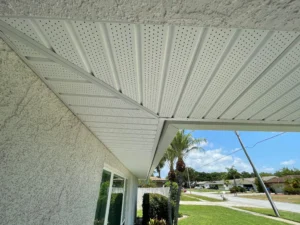
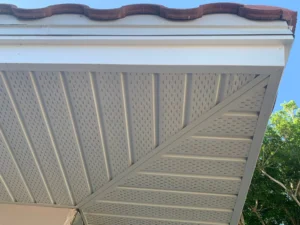
Soffit can be repaired after hurricane damage when three conditions are met: the damage is isolated to a single section rather than spread across the roofline, the wood framing underneath is solid with no rot or moisture damage, and only the surface ventilation panels need to be replaced. When any of those conditions isn’t met, particularly when the underlying wood is compromised, full replacement is required. The surface damage visible from the ground doesn’t always tell you which situation you’re in, that requires a hands-on inspection of the framing behind the panels.
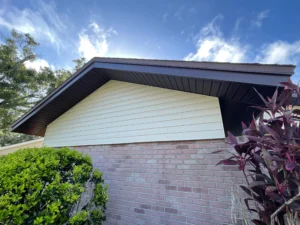
The condition of the wood itself is what determines whether a fascia board can be repaired or needs to be replaced. A fascia board that’s been physically displaced by wind but is still structurally sound can often be reinstalled and secured. A fascia board that shows rot, soft spots, or has separated from the rafter ends it’s attached to needs to be replaced before new soffit material goes on top of it. Painting or caulking over a damaged fascia board doesn’t fix the underlying problem, moisture infiltration continues and the rot spreads.
Structural integrity compromise in a soffit and fascia system means the framing components that the visible panels attach to, the rafter ends, fascia boards, and nailer framing, are no longer solid enough to properly support the installation. The most common cause in Florida is rot from moisture infiltration, which can develop from storm damage, years of inadequate ventilation, or previous repairs that didn’t address the substrate correctly. When framing is compromised, installing new surface panels over it produces a repair that looks correct but fails to fix the actual problem, and the failure continues underneath until it becomes visible again.
As quickly as possible. Every rain event that reaches open or damaged soffit after a hurricane adds moisture to the wood framing behind it, and in Florida’s humidity that moisture doesn’t dissipate quickly. An area where the wood framing is still solid immediately after the storm can develop rot within a few weeks if additional rain events occur before repairs are made. The difference between a repair scope and a replacement scope can change based on how long damaged sections are left exposed to weather, and prompt assessment keeps options open that delay closes off.