
In Florida, Hardie board fiber cement siding outperforms vinyl in every climate-relevant category. Vinyl warps in extreme heat, fades under UV exposure, and cracks when temperatures swing. Hardie board doesn’t warp, doesn’t rot, resists termites, and holds its factory paint finish for up to 15 years. The upfront cost is higher, but the long-term performance difference is significant.
Homeowners ask this question constantly. Vinyl or Hardie? And honestly, it comes up every week – because both options look reasonable on paper, both are widely available, and the price difference between them is real enough to make vinyl tempting. But Florida is a different climate than most of the country, and the material that works fine in a moderate climate can fail in ways you don’t expect here. Heat, UV intensity, humidity, and pests don’t give the wrong material much grace.
The question sounds simple. What does siding cost? But the honest answer is: it depends on what material you’re putting on the wall. The range across the four main categories is wide enough that “average siding cost” isn’t a single number. A vinyl siding price and a premium composite price are completely different conversations, and choosing without understanding why can lead to a decision that costs more in the long run than a slightly higher starting point would have.
.
“Homeowners ask us this every week.”
That line captures something real. It’s not a niche question – it’s the first question most Еhomeowners have when they’re planning a siding project. And it makes sense why. Vinyl and Hardie are the two most common residential siding materials. Both are installed on Florida homes. Both are available from most contractors. And the price gap between them is meaningful enough that choosing vinyl seems like a reasonable way to manage the budget.
The problem is that the price comparison doesn’t account for what happens after installation. A vinyl siding price per square foot is a material cost. It doesn’t include what you spend on it over the next 10, 15, or 20 years – the repainting when the color fades, the panel replacements when sections warp or crack from heat exposure, the maintenance that fiber cement simply doesn’t require at the same frequency.
So when someone asks “vinyl or Hardie,” what they’re really asking is a cost question. They just don’t always realize that the most important part of the cost comparison isn’t the installation price. It’s the total cost of ownership over the time they’re going to own the house.
“Vinyl warps in extreme heat, fades under UV, and cracks when temperatures swing.”
Those three failures aren’t theoretical. They’re what shows up on vinyl-sided homes across Tampa Bay after years of Florida sun and weather cycling.
Vinyl is a polymer. It expands and contracts with temperature changes, and in Florida’s summer heat – surface temperatures on a south-facing wall can climb well above ambient air temperature – vinyl panels can soften enough to lose their shape. Once a panel warps, it doesn’t recover. The installation technique accounts for some of this by leaving expansion gaps, but a panel that’s been through enough heat cycles over enough years develops a visual waviness that becomes obvious from the street.
This isn’t a failure mode that happens overnight. It’s gradual. At first it doesn’t seem serious. Then enough panels have changed shape that the wall surface looks uneven, and by that point, the repair isn’t patching one problem panel – it’s dealing with a systemic issue across the whole wall.
UV exposure fades vinyl color over time. Florida gets more annual UV intensity than most of the United States, and south and west-facing wall exposures take the most direct sun. The original color selection doesn’t hold forever. Lighter colors fade toward chalky white. Darker colors fade noticeably faster and more visibly. When the siding fades unevenly – which it does, because different wall elevations get different sun exposure – the home starts to look weathered before anything has actually failed structurally.
Field-painted vinyl can extend the appearance, but painting vinyl has its own complications. Factory finishes on vinyl don’t accept paint the same way fiber cement does, and repainting is a maintenance cost that accumulates over ownership.
Vinyl also cracks when temperatures swing. Florida has wide daily temperature variation in certain seasons, and nighttime lows can be dramatically cooler than afternoon highs. A material that expands significantly in heat and contracts in cooler temperatures, repeated over thousands of cycles, develops stress fractures over time. Impact from debris – a common occurrence in storm seasons – also cracks vinyl more readily than fiber cement.
A cracked vinyl panel looks bad, and replacement requires removing and re-installing the damaged panel along with the panels around it. It’s manageable. But it’s maintenance. Fiber cement doesn’t have this failure mode at the same frequency.
“Hardie board is fiber cement. It doesn’t warp, doesn’t rot, resists termites, and holds paint up to 15 years.”
James Hardie fiber cement is a cement-based exterior cladding made from a composite of Portland cement, sand, and cellulose fibers. The material is dimensionally stable – it doesn’t expand and contract with temperature the way vinyl does, which is why warping isn’t a failure mode on a properly installed Hardie installation. It’s not a polymer. Heat doesn’t soften it.
It also doesn’t rot. Vinyl doesn’t rot either, but Hardie’s advantage over wood-based materials on this dimension is significant. In Florida’s humidity, any wood component in an exterior wall assembly is a potential moisture problem. Fiber cement doesn’t absorb moisture the way wood does, so the rot failure mode that’s common on older homes with wood siding or wood-based composite siding simply doesn’t apply.
Termite resistance is a real benefit in Florida specifically. The Tampa Bay region has one of the highest subterranean termite pressure levels in the country. Wood siding and some composite products are vulnerable. Hardie fiber cement is not a food source for termites – the material doesn’t offer the organic content that termites require. That’s not a minor point on a Florida home.
And the factory ColorPlus finish holds paint for up to 15 years. That’s not a marketing claim – it’s a manufacturer specification with a warranty behind it. Compare that to vinyl, which fades without being repainted, or to field-painted fiber cement, which needs repainting on a 5 to 7-year cycle. A factory finish that holds for 15-plus years without repainting is a meaningful maintenance cost reduction over the ownership period.
RIA Construction has installed Hardie fiber cement on Tampa Bay residential exteriors for over 20 years. The performance difference between a well-installed Hardie system and vinyl becomes most visible around years 8 to 12 – when the vinyl installation is showing heat cycling effects and color fade, and the Hardie installation still looks close to the day it was put on.
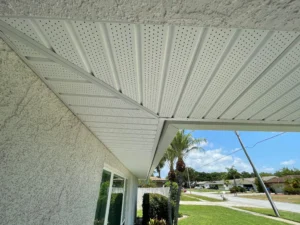
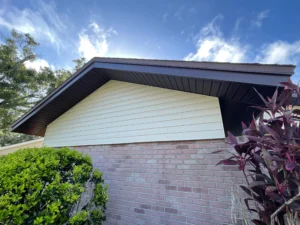
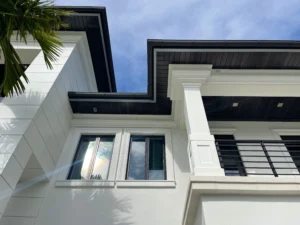
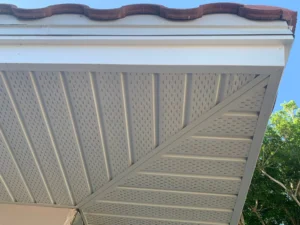
“Yes, it costs more upfront. But it lasts longer, requires less maintenance, and adds more to your resale value.”
That’s the honest framing of the cost comparison, and it’s the right framing. Hardie costs more than vinyl per square foot, both on material and on labor – the installation requirements for fiber cement, including Florida Building Code fastening standards for wind-load resistance, add to the labor side in a way that vinyl doesn’t require.
So the upfront number is higher. Sometimes meaningfully higher depending on the home, the profile selected, and the wall assembly work required.
But here’s what that number doesn’t capture. Vinyl in Florida requires attention over time. Faded panels get repainted or replaced. Warped sections get addressed. A home with 15-year-old vinyl siding in Tampa Bay has usually had some level of maintenance work on it. That’s not a criticism of vinyl – it’s just the reality of the material in this climate. Those maintenance costs add up. When you start accounting for them, the total cost comparison between vinyl and Hardie over a 15 to 20-year window looks different than the installation price alone suggests.
Resale value is also part of the calculation. Fiber cement siding is a recognized value-add in real estate. Buyers understand the material difference. A home with Hardie board in good condition commands a different conversation than a home with aging vinyl. How much that difference translates to dollars depends on the market, but the directional effect is consistent.
So when someone asks whether Hardie is worth the extra cost, the answer is: it depends on how long you’re going to own the house and how you’re thinking about total cost versus installation cost. For most Florida homeowners who are planning to stay in the home for more than five years, the math tends to favor fiber cement.
Ivan’s position in the video is direct: “In Florida, there’s really only one right answer.” That’s a real opinion from someone who installs both materials on Florida homes regularly. But it’s worth understanding where the nuance lives, because there are situations where vinyl is a reasonable decision.
Budget constraints are real. If the budget for a project genuinely doesn’t allow for fiber cement, vinyl installed correctly is a legitimate option. It’s not that vinyl fails immediately in Florida – millions of Florida homes have vinyl siding that’s been on the wall for 15-plus years. The point is that it requires more maintenance to get there and won’t look as good doing it.
Short-term ownership horizon is another factor. If someone is selling the house within two or three years, the upfront cost savings of vinyl may outweigh the long-term performance advantage of Hardie. The resale value difference between the two materials in a short sale window may not recover the installation cost difference.
And certain property types – rental properties, accessory structures, outbuildings – may have a different cost-benefit calculus than a primary residence. The durability argument for fiber cement is strongest when the homeowner is making a long-term investment in the property they’re going to live in.
But for a primary Florida residence where the homeowner plans to stay and wants the best long-term result for the money they’re putting into the exterior? The honest answer is Hardie.
Yes. Vinyl is a polymer that softens and expands significantly in high heat, and Florida’s summer wall surface temperatures – particularly on south and west-facing elevations – are well above what the material handles without stress over time. Heat cycling across many seasons gradually causes panels to lose their flat profile. A properly installed vinyl siding job accounts for expansion gaps, but enough heat cycles over enough years produce visible waviness that doesn’t reverse. It’s not a sudden failure. It’s a gradual one.
A properly installed Hardie fiber cement installation with a factory ColorPlus finish typically lasts 30 to 50 years on a Florida home, with the factory finish holding for 15-plus years before repainting is required. The material doesn’t warp in heat, doesn’t rot in humidity, and resists termite damage – the three primary failure modes that reduce the lifespan of other siding materials in Florida specifically. Lifespan depends on installation quality, wall assembly condition, and ongoing maintenance of caulked joints and trim, but the baseline performance of fiber cement in this climate is significantly longer than vinyl.
For most Florida homeowners planning to stay in their home for more than five years, the long-term cost comparison tends to favor fiber cement. Vinyl requires repainting, warped panels repaired or replaced, and delivers less to resale value than Hardie. The upfront installation cost of Hardie is higher, but when maintenance costs are factored in over 10 to 20 years and the resale value contribution is considered, the total cost difference narrows significantly. Whether it’s worth it for a specific homeowner depends on ownership timeline, budget, and priorities.
An accurate estimate for Hardie fiber cement installation requires an on-site assessment – wall type, existing substrate condition, vapor barrier situation, design profile, building height, and site access conditions all affect the final number in ways that can’t be accounted for from a phone conversation. RIA Construction provides on-site assessments for siding projects across the Tampa Bay area. The number from that assessment will account for all the project-specific variables rather than a per-square-foot ballpark that may not reflect the actual scope of work.