
A wood-look ceiling that requires no maintenance is a PVC composite panel system – specifically Sagiper – that replicates the appearance of real wood without any of the upkeep that actual wood demands. In Florida’s coastal climate, where humidity and moisture exposure accelerate the deterioration of traditional wood finishes, Sagiper offers the aesthetic of stained wood with none of the restaining, caulking, or painting cycles that come with it.
On a recent project in Tampa Bay, the installation team used Sagiper PVC composite panels on an interior ceiling. The result looks exactly like real wood. The maintenance requirement? Basically nothing. If it gets dirty, wash it. That’s it. No painting. No caulking. No restaining. Ever.
The starting point for aluminum siding is $1.15 per square foot. From there, it goes up based on the specific profile, gauge of the metal, and the complexity of the installation details on the home.
That starting price already puts aluminum above vinyl, which typically begins closer to $0.90 to $1.00 per square foot for the material, and above entry-level fiber cement. The reason is straightforward: it’s metal. The raw material cost is higher than polymer or cement-based products, and that difference carries through to the final price.
At the $2 to $3 range, aluminum siding is in the same territory as higher-end fiber cement profiles with factory finishes. That’s a comparison worth making deliberately, because at that price point, the question of which material makes more sense for a Florida home becomes genuinely important. Both are durable. Both handle weather exposure well. But their long-term performance characteristics, maintenance demands, and repairability are different in ways that affect the total cost of ownership over a 15 to 20-year window.
The $1.15 starting figure is a floor, not an average. A few things move the price upward quickly.
Profile matters. Aluminum siding comes in horizontal lap profiles, vertical configurations, and various texture options that replicate wood grain to different degrees. More complex profiles cost more. Gauge – the thickness of the metal – also affects both material cost and the long-term performance of the panel. Thinner gauge aluminum dents more easily. Heavier gauge costs more but holds its shape better over time.
And on a home with a complex roofline, multiple window openings, or architectural details that require custom cuts and trim work, labor complexity adds to the total. Trim pieces, inside and outside corners, J-channel at windows and doors – those details take time regardless of the siding material, and aluminum’s rigidity means some of those cuts require more precision than vinyl.
So when someone asks what aluminum siding costs in Tampa Bay, the honest answer is: it depends on the home. The $1.15 starting point tells you where the conversation begins, not where the estimate lands.
“Installation is straightforward. Repair is nearly impossible.”
That’s not an exaggeration. It’s a practical description of what happens when a single panel of aluminum siding gets damaged after the wall is complete.
With vinyl siding, panel replacement is manageable. A specialized zip tool unlocks the damaged panel from the one above it, the panel slides out, a new one goes in, and the job is done in a reasonable amount of time. The material’s flexibility makes that process work.
Aluminum doesn’t work that way. The panels are metal. They interlock differently. And when a single aluminum panel needs to be replaced between two panels that are already in place on a finished wall, the surrounding panels don’t flex the way vinyl does. Getting the new panel in without disturbing or damaging the ones above and below it is genuinely difficult. The kind of difficult that takes up to two hours for a single panel – and sometimes, even with that effort, it still can’t be done cleanly.
That’s not a theoretical problem. It’s what happens on actual repair calls on homes with aluminum siding in Tampa Bay and throughout Florida. A storm leaves a dent or a crack in one panel. The homeowner calls for a repair. And the realistic answer is that replacing just that panel isn’t going to work the way they’re expecting.
“In most cases, replacing the entire wall makes more sense than fixing one panel.”
When you hear that from a contractor, it can sound like an upsell. It isn’t. It’s the practical reality of how aluminum siding behaves once it’s been on a wall for years.
Here’s what usually happens. A panel gets damaged – from hail, debris impact, or something as simple as a ladder leaned against the wall at the wrong angle. The repair inquiry starts with “can you just replace that one panel.” And the answer, in most cases with aluminum, is that the single-panel repair either can’t be done cleanly or produces a result where the new panel doesn’t match the aged appearance of the panels around it.
Aluminum oxidizes over time. The surface finish changes. A new panel going into a wall full of older panels will stand out visually even if the installation itself goes perfectly. The color match isn’t there. The texture reads differently. And on top of that, getting the new panel in between two existing panels without causing damage can take as long as two hours – and may still not produce a satisfactory result.
So what usually happens in practice? The recommendation is to replace the full wall section rather than attempt the single-panel repair. It’s a more predictable outcome. The material matches. The installation is clean. And the wall looks right when it’s done rather than showing a patch that’s visually inconsistent with everything around it.
That’s not a blanket rule. Sometimes the damage is accessible enough, and the panel is in a location that allows replacement without disrupting the surrounding material. But homeowners should know before they choose aluminum siding that the repair situation is fundamentally different from vinyl, and that “just patch the damaged panel” is often not a realistic option.
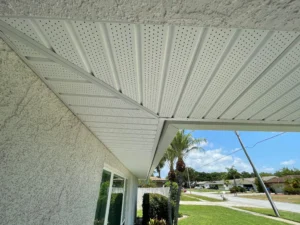
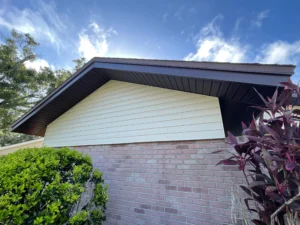
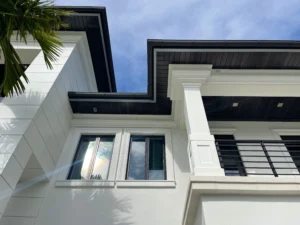
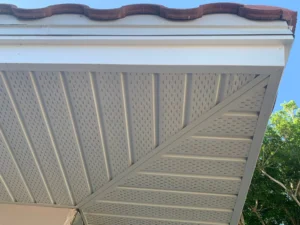
The three most common siding materials on Florida residential exteriors are vinyl, fiber cement, and aluminum. Each has a legitimate role. The question is which one makes sense for a specific home, a specific budget, and a specific set of long-term expectations.
Vinyl is the most cost-effective entry point. It handles Florida’s climate reasonably well, it’s the easiest to repair when panels get damaged, and the material cost is lower than both aluminum and fiber cement. The trade-off is that vinyl is the least architecturally substantial of the three – it can fade, it can warp if installed incorrectly, and it doesn’t replicate the look of higher-end materials as convincingly.
Fiber cement – James Hardie fiber cement, a cement-based exterior cladding engineered for moisture resistance, dimensional stability, and Florida’s extreme weather cycling – sits in the middle on cost but higher on performance. It resists moisture, termites, and UV degradation better than both vinyl and aluminum. The factory ColorPlus finish lasts 10 to 15-plus years without repainting. Repair, while more involved than vinyl, is more manageable than aluminum. And the material holds its appearance over a long ownership window in a way that the other two don’t consistently match.
Aluminum costs more than vinyl upfront, handles corrosion from salt air well, and has a long track record on coastal Florida properties. But the repairability issue is real and it should factor into the decision. On a home where the aesthetic goal is clean, painted metal siding with a long lifespan and the homeowner understands that repairs will likely mean wall section replacement rather than panel-level fixes, aluminum can be the right call. On a home where the homeowner wants flexibility in future repair scenarios, vinyl or fiber cement is more practical.
RIA Construction has worked with all three materials on Tampa Bay residential exteriors for over 20 years. The recommendation on any specific project comes from looking at the wall construction, the exposure conditions the home faces, the budget, and the homeowner’s realistic expectations for what maintenance and repair might look like over time. There isn’t a single right answer. There’s a right answer for the specific situation.
If you’re looking at aluminum siding near you in the Tampa Bay area, a few things are worth understanding before the estimate conversation starts.
First, the price. $1.15 per square foot is where aluminum begins, and the typical installed range for most homes runs higher than that once profile, gauge, and trim details are accounted for. Go into the conversation knowing that aluminum is not the budget option – it sits above vinyl and comparable to or above mid-range fiber cement.
Second, the repair situation. Ask your contractor directly: what happens if one panel gets damaged five years from now? On a well-done aluminum installation, that answer should be honest about the limitations. The installer should be upfront that panel-level repair is often not practical and that wall section replacement may be the realistic outcome for even localized damage.
Third, consider the exposure conditions specific to your home. Aluminum handles salt air corrosion better than many materials and has performed on Gulf Coast properties for decades. On a home directly facing the water, aluminum’s corrosion resistance is a genuine advantage. On a home further inland where salt air is a less constant factor, that advantage narrows and the repairability trade-off weighs more heavily in the comparison.
And finally: factor in the total cost over time, not just the installation price. A material that costs more upfront but requires minimal maintenance can cost less than a cheaper material that needs more regular attention. A material that requires full wall replacement for a single damaged panel can create unexpected costs that weren’t in the original budget calculation.
Aluminum siding starts at approximately $1.15 per square foot and typically runs $2 to $3 per square foot depending on profile, gauge, and installation complexity. That starting price is higher than both entry-level vinyl siding and entry-level fiber cement siding, driven by the cost of the metal material itself. The total installed cost for a complete home will also vary based on trim details, roofline complexity, and the number of window and door openings that require finishing work.
Repairing a single aluminum siding panel between two panels already in place on a finished wall is genuinely difficult. The panels interlock as a rigid metal system, and getting a replacement panel in without disturbing the surrounding material can take up to two hours – and still may not produce a clean result. In most cases, replacing the full wall section is more practical than attempting a panel-level repair, especially on older installations where the existing material has oxidized and a new panel would visually stand out from the panels around it.
Aluminum handles salt air corrosion better than many siding materials, which has made it a viable option on Gulf Coast Florida properties for decades. On homes with direct water exposure, that corrosion resistance is a genuine performance advantage. The trade-off is repairability: aluminum is harder to repair after storm damage or impact than vinyl or fiber cement. Whether that trade-off makes sense depends on the specific home, its location, and the homeowner’s realistic expectations for future repairs.
Aluminum and fiber cement siding occupy similar price territory at mid to upper ranges, but their performance characteristics differ in important ways. Fiber cement – specifically James Hardie fiber cement – offers a factory-applied finish that lasts 10 to 15-plus years without repainting, strong resistance to moisture and termites, and more manageable repair options than aluminum. Aluminum offers better corrosion resistance in direct salt air environments. The right choice depends on the specific exposure conditions the home faces and how much weight the homeowner places on future repairability versus coastal durability.