
That’s one of the first things homeowners ask us when they call. And honestly? It’s a fair question.
The problem is there’s no single number that works for every house. I know that’s not what people want to hear. But siding installation costs depend on many factors.
If a contractor gives a flat price before seeing your home, the estimate may miss key items.
So let me walk through what actually drives the price. What we look at when we put together an estimate. And what homeowners in Tampa Bay should realistically expect to budget for.
Material is usually the first major cost driver. And the range is pretty wide.
Vinyl siding installation is the most budget-friendly option. It handles Florida humidity well, it doesn’t rot, and it doesn’t require painting. For most homes around Tampa Bay, vinyl is a really practical choice. You’re typically looking at a lower cost per square foot compared to other materials – and the long-term maintenance savings are real.
Fiber cement – that’s what James Hardie makes – sits in the mid-to-upper range. It costs more than vinyl upfront. But it’s denser, more impact-resistant, and it holds paint longer. In coastal areas around Tampa, that durability matters. We see a lot of older homes with deteriorating wood or fiber cement that’s past its lifespan, and the replacement cost always comes down to what material makes sense for that specific house and budget.
Wood siding is the highest cost option. And honestly, in Florida? We don’t recommend it very often. The humidity exposure just creates ongoing maintenance costs that usually outweigh the aesthetic benefit.
So the first question that shapes the estimate is: what material is the homeowner going with?
This one’s obvious but worth explaining properly.
Siding is priced by square footage of exterior wall surface. A 1,500 square foot single-story ranch home has a very different surface area than a 2,500 square foot two-story house. So the size of the house matters.
But layout matters almost as much as size.
A house with a simple boxy shape? That’s faster and easier to side than a house with multiple gables, bay windows, dormers, or complicated rooflines. Every angle and corner adds labor time. Every penetration – windows, doors, vents, outlets – adds detail work that has to be done correctly to maintain a weathertight seal.
We’ve quoted two houses in the same neighborhood with similar square footage, and the estimate came out noticeably different because one had a straightforward layout and the other had multiple architectural features that added installation time.
That’s not unusual. That’s just how it works.
This is the part that sometimes catches homeowners off guard.
Removal and disposal of old siding adds cost to the project. And depending on what we find underneath, it can add more.
Sometimes we pull off old vinyl or wood siding and the wall sheathing underneath is in perfect shape. Clean, dry, solid. That’s the best-case scenario.
But sometimes – and this happens more often than people expect on older Tampa Bay homes – we pull off the old siding and find problems. Rotted sheathing. Moisture damage. Old insulation board that’s been compressed or compromised. Damaged house wrap.
All of that has to be addressed before new siding goes on. Because if we just side over a damaged substrate, we’re sealing a problem into the wall. And that problem gets worse.
I remember one house in Riverview where the original estimate was pretty straightforward. Then we removed the siding on the back wall and found two sections of sheathing that had been wet for what looked like years. Probably a slow leak from a window seal that nobody knew about. We had to stop, replace that sheathing, treat the framing, and then continue with the siding installation.
That kind of discovery changes the scope of the project. And it’s part of why experienced residential siding contractors won’t give you a firm price without doing a proper inspection first.
Florida has building codes that are stricter than most states. Especially around wind resistance.
After the hurricane seasons we’ve had in Tampa Bay, the state updated requirements for how exterior cladding systems have to be installed. That includes fastening patterns, fastener types, sealing methods, and in some cases product testing certifications that materials have to meet.
This affects house siding installation cost because doing it to code here isn’t the same as doing it to code in Ohio or Virginia. The fastening is more intensive. The sealing around penetrations is more detailed. Some products require specific installation methods to maintain their warranty in high-wind zones.
None of this is optional. If a contractor quotes you a number that seems unusually low, it’s worth asking what they’re doing differently. Sometimes the answer is that they’re cutting corners on the installation process itself.
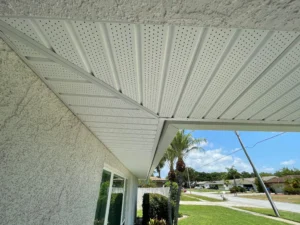
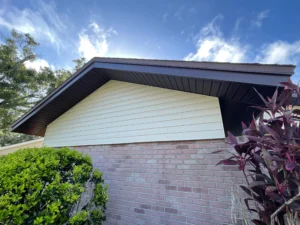
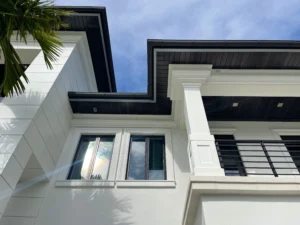
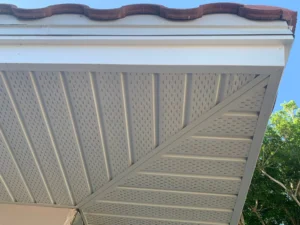
A lot of siding projects also involve soffit and fascia work at the same time. And that’s usually a good idea if the existing soffit and fascia are aging.
Here’s why.
If we’re already staging around a house to install siding, adding soffit installation or fascia replacement to the same project is more efficient than doing it as a separate project later. The mobilization cost is already there. The crew is already on site.
Aluminum soffit installation and fascia replacement add to the project cost, but not proportionally – because the labor overlap reduces the overall time spent on both.
And soffit and fascia repair done at the same time as siding makes the whole exterior system cohesive. New siding with deteriorating soffit panels just doesn’t look or perform right.
We also get into trim work. Window trim. Corner trim. J-channel around doors. All of those components affect both the look and the weathertightness of the finished project. And they affect the cost.
Skilled exterior labor in the Tampa Bay market has costs that reflect the local economy. And honestly, good installation crews are worth what they cost.
The labor component of a siding replacement project usually runs somewhere between 40 and 60 percent of the total project cost. That’s not unusual in the construction industry. And it’s part of why getting multiple quotes from contractors with different levels of experience can produce very different numbers.
A lower quote sometimes means less experienced crew. Or faster installation that skips details. Or material substitutions that aren’t immediately obvious.
The labor cost on a properly done vinyl siding installation – with correct fastening, proper flashing around openings, and clean finishing on corners and trim – reflects the time it actually takes to do that work right. Especially on older Tampa Bay homes with imperfect wall surfaces or original framing that’s been through decades of Florida weather.
Speed isn’t the goal. Getting it done correctly the first time is the goal.
So putting it all together – what should homeowners in Tampa Bay actually expect to budget?
For a typical single-story house with vinyl siding, straightforward layout, and sheathing in good condition, the project cost usually falls in a range that reflects material, labor, removal, and trim work. Add complexity — a second story, architectural details, damaged substrate, or premium fiber cement material – and the number goes up from there.
What I tell homeowners is this: a thorough inspection before the estimate matters more than the estimate itself. Because an estimate that doesn’t account for what’s actually on and behind your walls isn’t an accurate number. It’s just a starting point that’s going to change.
Get an inspection. Understand what you’re working with. Then compare estimates based on scope and materials, not just the bottom line number.
That’s how you avoid surprises in the middle of a project.
There’s no single average that applies to every house. The cost depends on house size, layout complexity, material choice, existing substrate condition, and whether soffit and fascia work is included. Vinyl siding installation typically runs lower than fiber cement, and single-story homes cost less than two-story homes with architectural details. A proper on-site inspection is the only way to get an accurate number.
Removal and disposal adds to the project cost, yes. But the bigger variable is what we find underneath. If the wall sheathing is in good condition, the additional cost is predictable. If there’s moisture damage, rot, or compromised substrate, that has to be addressed before new siding goes on – and that can add to the scope. Skipping that work and siding over a damaged wall isn’t a real option if you want the installation to last.
For most homes in the Tampa Bay area, vinyl is a very practical choice. It resists moisture, doesn’t rot, and doesn’t require painting. Modern vinyl siding installation products are engineered to handle Florida humidity and heat expansion. It’s the most cost-effective option for homeowners who want a durable exterior without the higher upfront cost of fiber cement.
Florida building codes for wind resistance are stricter than most of the country, which affects installation requirements and material specifications. Coastal air, extreme humidity, and hurricane exposure also mean that installation methods and material choices here are built around conditions that national averages don’t account for. A residential siding contractor working in Tampa Bay is building to Florida standards, not average national conditions.
If the soffit and fascia are aging or showing wear, doing it at the same time as siding replacement is usually more cost-efficient. The crew is already on site and staged around the house. Aluminum soffit installation and fascia work done simultaneously with siding avoids a second mobilization later and creates a cohesive exterior system. It’s worth discussing with your contractor during the inspection.
Compare estimates based on scope, not just the final number. A lower quote that doesn’t include removal, substrate inspection, proper flashing, or trim work isn’t actually a lower price – it’s an incomplete scope. Ask each contractor what’s included and what happens if they find damage underneath. A contractor who answers those questions clearly is usually the one whose estimate will hold up through the project.