
A lot of homeowners in the Tampa Bay area come to us frustrated. The AC is running constantly, certain rooms just will not cool down, and the electric bill keeps climbing. First thing most people do is call an HVAC technician. Which makes sense. That’s usually the logical first call.
But sometimes – not always, but sometimes – the problem isn’t just the system inside. Part of it is what’s happening on the outside of the house.
Old siding. Warped panels. Gaps. Sections that were never installed right. Stuff like that. When the exterior isn’t doing its job, the inside of the house has to work a lot harder than it should. Especially down here, where the sun and humidity don’t really take a break.
If the outside of the house isn’t holding its own, the system inside has to pick up the slack. And that costs you.
It’s not a wrong instinct to call the HVAC company. Genuinely. If the AC is undersized, or old, or the duct work has issues – yeah, that’s going to affect comfort. That’s a real thing.
But here’s what gets missed a lot. The air conditioning system is responding to conditions. It’s trying to hold a temperature. And if heat is entering the house through failing exterior walls – through old siding with gaps, or warped sections, or panels that have shrunk over time – the AC is just chasing a moving target. It can’t win. It runs and runs and the room still doesn’t feel right.
We’ve done jobs in Tampa Bay where a homeowner had already spent real money on HVAC upgrades. New unit, programmable thermostat, the works. And it helped some. But those specific hot rooms, the west-facing bedroom, the bonus room above the garage – still uncomfortable in the afternoon. Still stuffy. Still expensive.
In a few of those cases, the siding on that side of the house was the issue. Once we dealt with the exterior, things changed. Not magically, but noticeably.
That’s why it’s worth looking at the whole picture. Not just what’s running inside.
So here’s how this actually works. Siding isn’t just cosmetic. It’s part of the house’s protective system. Done right, it helps manage heat, moisture, and air movement at the wall level.
When siding fails – or when it was never installed well to begin with – you start to get problems that affect how the house performs thermally.
Florida sun is relentless. In Tampa Bay, you’re dealing with high UV and intense heat for a long stretch of the year – not just a couple of warm months. When siding is cracked, warped, or has gaps, solar heat can penetrate the wall assembly more aggressively. It transfers inward. You feel it as warmth coming through the walls themselves.
Old or deteriorated siding does a poor job of reflecting or deflecting that heat load. New vinyl siding, installed correctly with a proper house wrap behind it, creates a more solid barrier. Not perfect – nothing is – but noticeably better.
This is a big one people don’t think about. Siding with gaps – loose panels, sections that have come away from the wall, corners that aren’t sealed – allows conditioned air to escape and outside air to enter. You’re cooling your house and some of that effort is literally leaving through the walls.
Insulation does a lot of work against this. But the siding layer is supposed to be working with the insulation, not against it. Siding with significant air leakage undermines everything else.
This is the Tampa Bay specific issue that changes everything. The humidity here is not a minor variable. It is constant. And failing siding lets moisture get into the wall system in ways that aren’t always visible from the outside.
Moisture in the wall assembly can compromise insulation performance over time. It can cause subtle structural degradation. It can quietly make the wall system less thermally effective, even before you see obvious damage like rot or visible swelling.
Old siding, especially in humid coastal environments, often has hidden moisture intrusion that homeowners don’t find out about until a repair or replacement job opens up the wall.
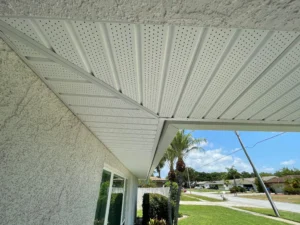
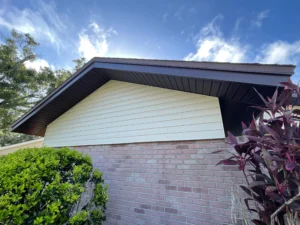
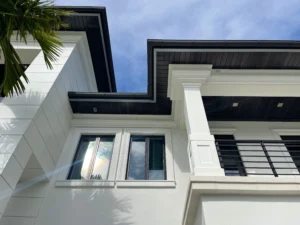
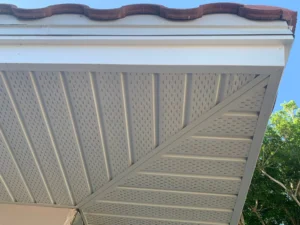
Vinyl siding has become the practical go-to for Florida homes, and there are real reasons for that. It doesn’t rot. It handles humidity well. It’s dimensionally stable under heat, better than wood for sure, reasonably well compared to some other options. And when it’s properly installed with a quality house wrap behind it, it creates a cleaner, more consistent exterior system.
So yes, replacing failing siding with new vinyl siding can improve the exterior’s thermal performance. That’s real. But I want to be straight about what makes the difference.
New siding installed without proper house wrap, or over a compromised wall, will underperform. The siding material is only part of the equation.
The house wrap matters. What’s behind the siding matters. If the wall cavity has moisture damage or poor insulation, the new siding helps, but it doesn’t fix those underlying issues. We always look at the full wall condition before recommending replacement, because there’s no point putting good siding over a bad situation.
Installation quality is the other variable. Vinyl siding installed with gaps, improper overlapping, or cut corners on flashing and corner trim will not perform the way it should – regardless of the material quality. And in Florida, where wind-driven rain is a real event, that matters even more.
A lot of people use these terms interchangeably and they shouldn’t. There’s a meaningful difference.
Standard vinyl siding is a hollow profile. It creates a physical barrier against the elements, manages moisture at the surface level, and – when installed with a quality house wrap – does a solid job of protecting the wall assembly. Most vinyl siding is standard vinyl.
For most Florida homes, standard vinyl siding installed correctly with a good house wrap behind it is a reasonable, effective choice. It’s not without thermal benefit. But it’s not specifically engineered to add insulation value.
Insulated vinyl siding has a rigid foam backing adhered directly to the back of the panel. The foam fills the profile of the panel, so instead of hollow sections behind each panel, you have foam sitting between the siding and the wall.
This adds genuine R-value – usually somewhere in the R-2 to R-4 range depending on the product. That’s not dramatic. It’s not going to replace proper wall insulation. But it does add measurable thermal resistance, and it also adds some rigidity to the panel itself.
For homes where exterior wall insulation is limited, or older homes where the wall assembly just wasn’t built with great thermal performance, insulated vinyl siding can make a more noticeable difference. Whether it justifies the cost difference versus standard vinyl depends on the specific house. That’s an honest answer.
In Tampa Bay’s cooling-dominated climate, the benefit from insulated vinyl tends to show up in reduced heat transfer through the walls on those brutal afternoon exposures. But I’d be overstating it if I said it was a game-changer on its own. It’s a meaningful upgrade for the right situation. Not a magic fix.
Tampa Bay is not the same situation as, say, upstate New York where the concern is keeping heat in during winter. Here, it’s almost entirely about keeping heat out for most of the year.
The sun hits hard. The heat index during summer months is relentless. And unlike a lot of Northern climates, Florida homes are under solar and humidity stress for a long, continuous stretch – not a few months. This accelerates exterior wear on siding in ways that homeowners often don’t account for.
All of this adds up to one thing: siding ages faster in Florida, and when it starts to fail, the performance drop is real. Old Tampa Bay siding from fifteen or twenty years ago that hasn’t been touched is often well past its useful life, even if it still looks okay from the street.
Some of these are obvious. Some aren’t. Here’s what we look at when we’re evaluating a home for this kind of work.
Not every one of these is automatically a reason to replace everything. But several of them together, on a home that’s fifteen or more years old, usually tells a clear story.
The pattern that concerns us most is when a homeowner has had small repairs done two or three times on the same sections. That’s usually the wall trying to tell you something.
This is the conversation we have on a lot of estimates, and I’ll be direct about how we think through it.
Not every siding issue is a full replacement job. Sometimes one panel got damaged – a trim piece took a hit from a lawn mower, or a specific section on one wall got knocked. That’s a repair. Straightforward. We deal with it, match the material as close as we can, and it’s done.
But there’s a different situation, and it’s more common than people want to hear. When siding is old across the whole house – or across a significant portion of it – and it’s showing multiple signs of wear, and it’s been repaired a couple of times already… at that point, repairs start to become an ongoing cost that doesn’t really fix the underlying problem.
Here’s what we mean when we say old siding can cost you twice. The repair bill is obvious. But the efficiency cost is running in the background, quietly.
If that aging siding is contributing to heat intrusion, even modestly, you’re paying it back every month on your electric bill. Month after month. Year after year. That’s a hidden cost that doesn’t show up as a single line item, so people don’t always connect it to the siding. But it’s real.
Add the repair costs over a few years, and then add the accumulated efficiency loss, and the math on full replacement often starts to look more reasonable than it did at first.
Sometimes a repair job uncovers something unexpected. We open up a section of wall and find moisture damage behind the siding that nobody knew was there. Compromised sheathing. Insulation that got wet at some point. In those cases, the repair cost changes and the case for addressing the whole thing gets stronger pretty fast.
This doesn’t mean we push toward replacement every time. It means we look at what’s actually there and give an honest read on whether patching makes sense or whether the home is at a point where keeping up with repairs is just a slow way to spend more money.
If you’re trying to figure out whether your siding situation is worth addressing for energy efficiency reasons, here’s roughly how we’d walk through it.
Age of the siding matters. Most vinyl siding has a useful life of twenty to thirty years, depending on conditions and installation quality. In Florida, conditions are harder. If your siding is fifteen-plus years old and showing wear, it’s worth a real look – not assuming it’s fine because it hasn’t visibly fallen off.
Extent of the damage matters. Is it isolated to one wall, one elevation, a few specific sections? Or is it general across the exterior? Isolated problems are usually repair territory. Widespread wear is a different conversation.
What’s underneath matters. If the siding has been letting moisture in for a while, the repair-versus-replace question may come with a wall condition question attached to it. You can’t really answer one without at least checking the other.
Whether patching is still financially logical matters. If you’ve already had two or three repairs on the same sections, or if you’re looking at multiple problem areas that are going to need attention in the next year or two anyway, replacement can actually be the more sensible financial call. Not always. But often.
Honestly, the best thing anyone in the Tampa Bay area can do is have someone look at it with fresh eyes. Not to push toward replacement – but to tell you clearly what’s there, what it means, and what the options actually are. That’s what we try to do on every estimate.
Vinyl siding won’t fix everything. But old, failing siding that’s letting heat in and costing you every month on your electric bill? That’s a problem worth solving.
Can vinyl siding help lower my energy bills?
It can, yeah – but it depends on what’s going on with your current siding and wall system. If your existing siding is old, warped, gapped, or failing, replacing it with new vinyl siding installed correctly with a quality house wrap can reduce heat intrusion and air leakage at the wall level. That means your AC doesn’t have to work as hard to maintain the same indoor temperature. The result shows up over time in your cooling bills. That said, vinyl siding is not a substitute for proper insulation or HVAC performance. It’s one part of the system. If your siding is in reasonable shape, replacing it just for energy reasons probably isn’t the first move. But if it’s already showing age and wear, the efficiency benefit is a real part of the replacement value.
What is the difference between standard and insulated vinyl siding?
Standard vinyl siding is a hollow profile – it creates a barrier and manages moisture, but there’s an air gap between the panel and the wall. Insulated vinyl siding has a rigid foam backing bonded directly to the panel. That foam fills the hollow section and adds genuine thermal resistance, usually in the R-2 to R-4 range depending on the product. It also makes the panel feel more solid and rigid. For most Florida homes, standard vinyl installed with a good house wrap does solid work. Insulated vinyl makes more of a noticeable difference when the wall behind it doesn’t have a lot of insulation already, or when you’re dealing with older construction where the wall assembly just wasn’t built with great thermal performance. Whether the cost difference is worth it for your specific situation is something we’d talk through on an estimate.
How do I know if my old siding is hurting my home’s efficiency?
A few things to look for. Visible warping, bowing, or cracking in the panels. Gaps at seams, corners, or where the siding meets trim or windows. Panels that feel loose or move when you press on them. Inside the house, if you have specific rooms – especially on sun-exposed walls – that consistently run hotter and don’t cool down the way the rest of the house does, the exterior on that wall is worth examining. If your cooling bills have been climbing without an obvious reason and your HVAC is functioning normally, that’s another signal. And if you’ve had siding repairs done more than once on the same sections, that’s usually telling you the material is past the point where repairs are the right call. In Tampa Bay, siding that’s fifteen or more years old and showing any of these signs is worth having someone walk around and look at.
Is replacing old siding worth it in Florida?
In the right situation, absolutely. Florida’s climate is harder on exterior materials than most places in the country – the UV load, the humidity, the thermal cycling, the storm exposure. Siding ages faster here, and when it starts to go, the problems compound. If your siding is old and failing, you’re often paying on two fronts: the repairs themselves, and the quiet efficiency loss that shows up every month on the electric bill. When we add both of those costs up over a few years and compare them to the cost of a full replacement with quality vinyl siding and proper installation, replacement often comes out as the more sensible financial decision. Not always – it depends on the extent of the problem and the condition of the underlying wall. But for a lot of older Florida homes where the siding has been silently degrading, replacement is worth it. Not just for curb appeal. For long-term performance and cost.