
A wood-look ceiling that requires no maintenance is a PVC composite panel system – specifically Sagiper – that replicates the appearance of real wood without any of the upkeep that actual wood demands. In Florida’s coastal climate, where humidity and moisture exposure accelerate the deterioration of traditional wood finishes, Sagiper offers the aesthetic of stained wood with none of the restaining, caulking, or painting cycles that come with it.
On a recent project in Tampa Bay, the installation team used Sagiper PVC composite panels on an interior ceiling. The result looks exactly like real wood. The maintenance requirement? Basically nothing. If it gets dirty, wash it. That’s it. No painting. No caulking. No restaining. Ever.
Real wood ceilings look great. That part isn’t debatable. The problem is what happens to them over time, especially in Florida.
Most wood ceiling products used on covered porches, outdoor living areas, and interior spaces near exterior walls are stained rather than painted. And stain is not a one-time application. Depending on sun exposure and humidity, restaining typically needs to happen on a cycle of several years. The finish breaks down. The wood starts absorbing moisture. If you catch it early, you restain. If you don’t, the wood starts to deteriorate.
“Compared to the wooden products, which are stained usually, you have to re-stain sometimes. You’re not going to have that problem with the Sagiper.”
That’s the core of it. It’s not that real wood can’t look beautiful here. It’s that maintaining that look in Florida requires a recurring commitment most homeowners don’t fully anticipate when they’re making the original material decision. Year-round humidity. Moisture in the air. UV intensity that accelerates finish breakdown. Add those factors together and a wood ceiling that looks perfect in year one can start to show wear well before most homeowners expect.
And honestly, the issue isn’t just aesthetics. When wood absorbs moisture repeatedly over years, the degradation goes deeper than the surface. Paint or stain failure is the early warning sign. What follows, if nothing is done, is more serious.
Sagiper is a PVC composite panel – a synthetic material engineered to replicate the visual character of real wood grain. The texture, the profile, the warmth of the appearance. It’s relatively new to the market compared to traditional wood and vinyl products, but it’s gaining ground on Florida exterior and interior projects for one straightforward reason: it delivers what homeowners actually want from a wood ceiling without what they don’t want.
“This product mimics the wood. You can see it on the ceiling, but it’s a PVC composite, so it’s completely maintenance-free.”
PVC composite doesn’t absorb moisture. It doesn’t swell from humidity. It doesn’t need a protective coating to prevent deterioration. The surface finish is part of the material itself – not something applied on top that will eventually break down and need to be reapplied.
That distinction matters more in Florida than almost anywhere else. Most exterior and semi-exterior ceiling materials rely on a surface finish – paint, stain, sealant – to protect the substrate from moisture. That surface finish is what fails first. In a high-humidity coastal environment like Tampa Bay, that failure happens faster. Sagiper removes that failure point entirely because there’s no separate protective layer to maintain.
People sometimes assume the wood look is a printed graphic layer that will fade or peel. It isn’t. The texture and color run through the material consistently, which is part of why it holds its appearance over time without requiring a maintenance cycle to keep it looking right.
Here’s a simple way to think about the difference.
Real wood ceiling: looks beautiful at installation. Requires restaining on a cycle of roughly three to five years depending on exposure. If the stain maintenance slips, moisture absorption begins. From there the wood can warp, crack, or begin to rot if the underlying conditions are wet enough. In a Florida coastal environment, that cycle is compressed compared to drier climates.
Sagiper PVC composite: looks like real wood at installation. Requires washing if it gets dirty. That’s the maintenance list.
The cost picture is worth considering here too. The material cost of Sagiper is comparable to quality stained wood products. But when you factor in the cost of restaining over a 10 to 20-year window – material, labor, the scaffolding or equipment needed to reach a ceiling – the total cost of ownership for a real wood ceiling almost always exceeds Sagiper. Sometimes significantly.
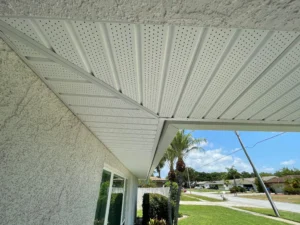
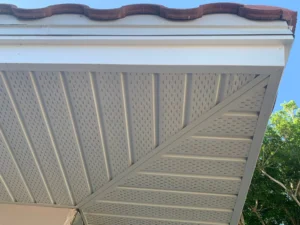
Standard vinyl soffit panels are the most common low-maintenance ceiling material on Florida homes. They work fine for utilitarian soffit applications. But they look like vinyl. The flat, perforated panels that most people associate with soffit are recognizable, and they don’t read as a design-forward choice on a covered porch or outdoor living ceiling where appearance matters.
Sagiper sits in a different category. It’s not trying to be structural soffit material. It’s trying to be a ceiling material that looks like natural wood while performing like a synthetic. Those are different goals, and the product delivers on both. You get the visual warmth of wood in a space where it’s visible and appreciated, without inheriting the maintenance obligation that real wood carries.
The project in the video uses Sagiper on an interior ceiling. But the product’s application range is broader than that.
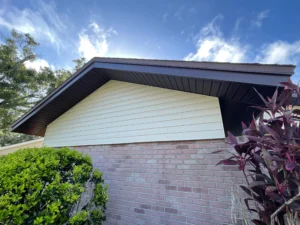
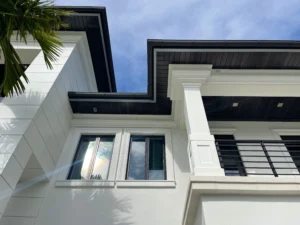
On coastal Florida homes, the installation team uses Sagiper on exterior covered porch ceilings, outdoor living spaces, soffit systems at roof overhangs, and interior ceiling applications where the wood look is part of the design intent. It handles direct humidity exposure, making it practical for both interior and exterior ceiling applications in Florida’s climate.
The material also works as a siding product on accent walls and architectural features, which is how Ivan described it in a separate project walkthrough: “You can do soffit with it, you can do siding.” That flexibility makes it useful on projects where design consistency across different surfaces matters – using the same material profile on the ceiling and the soffit, for example, creates a cleaner visual result than mixing products.
In the Tampa Bay area, RIA Construction has installed Sagiper on coastal properties from Madeira Beach to St. Petersburg and surrounding communities where salt air and humidity create real performance demands. The product holds up in those conditions in a way that real wood consistently doesn’t, which is ultimately why it keeps showing up on projects where the homeowner wants a wood look and doesn’t want to deal with the maintenance that comes with it.
One thing that sometimes surprises homeowners: Sagiper installation isn’t dramatically more complicated than standard wood or vinyl ceiling installation. The panels fit together cleanly, the profiles are consistent, and experienced installers can work efficiently with the product.
What matters more than the installation complexity is the preparation of the substrate. Any ceiling application – wood, vinyl, or PVC composite – depends on the framing or support structure being sound and properly aligned. Sagiper is no exception. The material itself is maintenance-free, but it still needs to be installed correctly to perform correctly over the long term.
No caulking required between panels. No painting after installation. No sealant application. Once the panels are in and the trim is finished, the project is done. That’s part of what makes the finished result so clean – there’s no wet-trade follow-up work happening after the installation is complete.
Sagiper PVC composite panels require no painting, no caulking, and no restaining. The only maintenance the product needs is washing if the surface gets dirty. There’s no protective coating to reapply because the surface finish is part of the material itself rather than a layer applied on top. In Florida’s climate, where humidity and UV exposure accelerate the breakdown of painted or stained finishes on real wood, that difference is significant over a 10 to 20-year ownership window.
Sagiper is used on both interior and exterior ceiling applications, including covered porch ceilings, outdoor living areas, roof overhangs, and soffit systems. The PVC composite base doesn’t absorb moisture and doesn’t degrade from humidity or salt air exposure, making it well-suited to Florida coastal properties where those conditions are constant. It’s one of the reasons it keeps appearing on Gulf Coast projects where the homeowner wants a wood-look ceiling without the maintenance that real wood demands in that environment.
Real wood stained ceilings require restaining on a cycle of roughly three to five years depending on exposure conditions, and in Florida’s coastal climate that cycle is often compressed. When the stain maintenance slips, moisture absorption begins, and from there the wood can warp or begin to deteriorate. Sagiper looks nearly identical to real stained wood from a normal viewing distance but requires no stain maintenance at all. Over a 15 to 20-year period, the total cost of ownership for Sagiper is generally lower than real wood when ongoing restaining labor and materials are factored in.
Beyond interior and exterior ceilings, Sagiper can be used for soffit installations at roof overhangs, accent siding on architectural features, and exterior design details where a wood appearance is part of the design intent. Its moisture resistance and maintenance-free performance make it practical across multiple surfaces on the same project, which is useful when design consistency between the ceiling and soffit materials matters. It’s been used on Florida coastal projects in both roles simultaneously, creating a unified wood-look system across visible ceiling and soffit surfaces without introducing any real wood into the assembly.