
If you’re getting quotes for Hardie siding and the numbers seem all over the place, you’re not imagining it. Fiber cement pricing has a wider range than most people expect – and the difference between a $1 per square foot job and a $3 per square foot job isn’t random. It comes down to which product you’re using and what the design requires. Here’s how it actually breaks down.
When people call us at RIA Construction about siding, the first question is almost always about material. Vinyl or Hardie? And honestly, once you understand what Tampa Bay homes go through – the humidity, the storms, the salt air – the answer gets pretty clear pretty fast.
We’ve been doing this work in the Tampa Bay area for over 20 years. We’ve seen how fiber cement holds up over decades in Florida conditions, and we’ve also seen what happens to materials that weren’t built for this climate. So let’s walk through what we actually see in the field.
Most people hear “fiber cement” and think it’s just another version of vinyl – or something fancy and expensive. It’s neither of those things.
Fiber cement is made from a mix of cement, sand, and cellulose fibers. That combination gives it properties that wood and vinyl simply can’t match. It doesn’t warp. It doesn’t rot. It doesn’t crack the way wood does when moisture cycles through it season after season.
And this is where people sometimes get confused – they think the wood-grain texture means it acts like wood. It doesn’t. That texture is surface-level. What’s underneath is a non-combustible, pest-resistant, dimensionally stable panel that just happens to look like natural wood.
So what you’re getting is the aesthetic of wood without any of the vulnerabilities. In Florida, where moisture is constant and storm season is a real variable every year, that trade-off matters a lot.
James Hardie is the dominant brand in fiber cement for a reason. Their product is engineered for specific climate zones, and the Florida version is built to handle what Gulf Coast homes actually face – high humidity, UV exposure, wind loads, and salt air in coastal areas.
At RIA Construction, we specify Hardie because we’ve installed it on hundreds of Tampa Bay homes and we know how it performs long-term. The deep wood-grain texture holds paint differently than wood does. Color lasts longer. Maintenance cycles stretch out. For homeowners who are tired of repainting every few years, that’s a meaningful difference – and one we see play out on projects across Hillsborough, Pinellas, and Pasco counties.
If you want a side-by-side look at how Hardie compares to vinyl on cost, maintenance, and durability, we cover that in detail in our guide
This is the part most people don’t see – and honestly, it’s the most important part of any siding replacement. It’s also what separates how we do it at RIA Construction from contractors who are just focused on speed.
A quality installation doesn’t start at the surface. It starts underneath. Before any new siding goes on, we remove the old material completely. Not cover over it. Remove it.
Why? Because what’s underneath tells you everything. We regularly find moisture damage in the substrate that was completely hidden by the old siding. We find rot in the sheathing that’s been sitting there for years. If you don’t address that before you close it up, you’re locking the problem inside the wall – and it keeps going.
So what usually happens on a proper RIA install is this: we strip everything, inspect the entire wall assembly, and then build a clean waterproof base – either plywood sheathing or a ZIP system. The ZIP system is a structural panel with a built-in weather barrier. More involved, more thorough. But it’s the kind of base that gives the new siding the performance it was designed to deliver.
People sometimes ask why one contractor quotes significantly lower than we do. Sometimes it’s because they’re not doing this part. They’re going over existing material, or skipping the substrate inspection altogether. That works until it doesn’t – and when it fails, it fails inside the wall where you can’t see it.
The ZIP system creates a continuous air and moisture barrier at the sheathing level. Instead of relying on house wrap – which can tear, gap at seams, or get improperly installed – you have a structural panel that handles both functions in one layer.
In Tampa Bay’s climate, where humidity gets into everything, that matters. We use the ZIP system on full replacement projects where we’re replacing the substrate anyway. It’s the difference between a wall assembly that actively manages moisture versus one that just hopes moisture stays out.
For more on how we approach the wall assembly on a full replacement, see our overview.
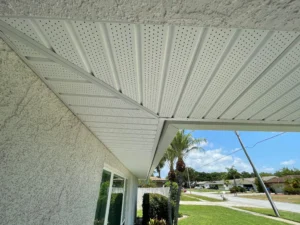
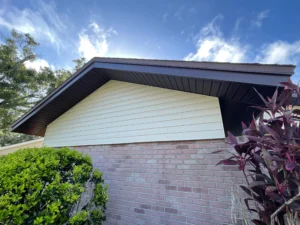
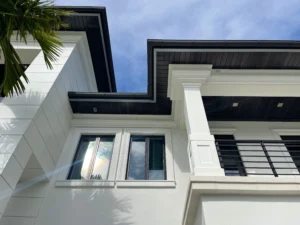
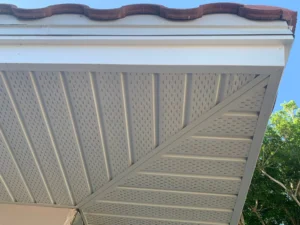
Florida isn’t like most of the country when it comes to exterior materials. You’ve got a coastal environment, salt air in a lot of areas, heavy rain events, serious UV exposure, and then storm season on top of it.
Fiber cement handles all of that differently than vinyl does. Vinyl is a plastic product. In extreme heat it softens. In impact situations it can crack. It’s lighter, which means in high-wind conditions it behaves differently than a heavier, more rigid material.
Hardie siding is rated for sustained wind resistance at levels that actually matter for Florida Building Code compliance. That’s not a marketing claim – it’s a code requirement we check on every project we do at RIA Construction. Non-combustible construction also affects insurance ratings in certain areas, which is a practical concern for a lot of our customers.
And because fiber cement doesn’t absorb moisture the way wood does, it doesn’t give pests the foothold they’re looking for. Termites are a real concern in Hillsborough County. So is wood-boring beetle activity. Fiber cement simply doesn’t give them what they need to establish – which changes the long-term maintenance picture significantly compared to wood siding or even some composite options.
Non-combustible means exactly that – fiber cement doesn’t ignite. This can affect your homeowner’s insurance rating, and in some Florida communities near wildland-urban interface areas, it matters for code compliance as well.
At RIA Construction, all our installations follow Florida Building Code requirements. We don’t cut corners on fastener patterns, flashing details, or clearance requirements. Those things matter for the warranty, they matter for code, and they matter for how the product actually performs over time.
This comes up on almost every call we take. People want to know: do I need to replace the whole thing, or can we just fix what’s damaged? The honest answer is – it depends on what’s happening underneath.
If you have isolated damage – a few boards took a hit, everything else is solid, the substrate is clean – repair can make sense. We replace what’s damaged, match the profile and finish as closely as possible, and you’re done.
But if the damage is spread across multiple areas? If the siding is over 15 years old and starting to show moisture-related issues in more than one location? At that point, repair becomes a game of whack-a-mole. We fix one spot and find another one six months later. We see this pattern a lot on homes in Lutz and the Carrollwood area where the original siding is getting up there in age.
The other scenario that consistently tips the decision toward full replacement is when we open something up and find substrate damage that wasn’t visible from outside. At first it looks like a surface issue. But then we pull the board and the sheathing behind it is compromised. Once that starts happening, it’s usually not isolated to one section.
If you’re looking for a siding contractor near you in Tampa Bay and wondering whether your situation calls for repair or replacement, the only reliable way to know is to have someone actually inspect the wall assembly – not just eyeball the exterior. That’s how we approach every assessment at RIA Construction.
Material age matters, but it’s not the only thing. A 20-year-old Hardie installation that was done correctly and maintained properly can have another 20 years in it. Vinyl at the same age might be at its functional limit – UV degradation, brittleness, color fade, seam failures.
We’ve walked away from repair quotes and recommended replacement when we found the underlying wall wasn’t worth patching over. And we’ve told homeowners they didn’t need a full replacement when the damage was genuinely isolated. We’d rather give the right recommendation than sell the bigger job.
People want a number, and that’s completely understandable. But the average siding replacement cost in Tampa Bay varies enough that quoting a single figure without context isn’t actually useful. Here’s what we actually look at when we’re building a quote at RIA Construction:
Fiber cement costs more upfront than vinyl, consistently. But the maintenance cycle is longer, the durability is higher, and the resale value impact is measurable. For most homeowners in this area, the 10- to 15-year view makes fiber cement the better financial decision. We see that reflected in our customers’ home sale outcomes when we follow up years later.
We’ve been doing siding, soffit, and fascia work in the Tampa Bay area for over 20 years. Most of our new business comes from referrals – homeowners who’ve seen our work on a neighbor’s house or been recommended by someone we worked with years earlier. That’s the metric we care about most.
• 20+ years of experience working on Tampa Bay and Gulf Coast homes |
• Specialized in fiber cement and moisture-prone coastal siding systems |
• All installations follow Florida Building Code requirements |
• Full wall assembly inspection before any material recommendation is made |
• 10-year workmanship warranty on completed installations |
• Locally owned and operated – we work in the same communities our customers live in |
For most Tampa Bay homeowners, yes – but the honest answer depends on your timeline and what you want to deal with over that period. Vinyl has a shorter lifespan and costs more to keep looking right over time. Hardie holds its finish longer, resists impact and moisture better, and consistently holds resale value in Florida’s coastal environment. We’ve installed both materials extensively at RIA Construction, and on a 10-plus year view, the math almost always favors fiber cement.
Technically possible in some situations, but not how we do it at RIA Construction – and not how a quality installation should be done. The right approach is to remove existing material first so the substrate can be inspected. Installing over old siding hides whatever is happening underneath – moisture damage, rot, gaps in the weather barrier. You won’t know what you’ve covered up until it becomes a much bigger problem later.
If the damage is truly isolated – one area, solid substrate behind it, siding otherwise in good shape – repair is a reasonable option. The problem is that surface-level damage often signals something happening in the wall assembly that isn’t visible until you open it up. When we do an assessment at RIA Construction, we look at the whole wall, not just the damaged section. That’s the only way to give a recommendation you can actually trust.
The ZIP system is a structural sheathing panel with a built-in air and moisture barrier – it replaces standard OSB or plywood plus house wrap in a single product. In Florida’s climate, it creates a more consistently sealed wall assembly than traditional layered approaches. We use it on full replacement projects at RIA Construction where the substrate is being replaced anyway. Not every project requires it, but on homes in Tampa Bay’s more moisture-exposed areas – coastal Pinellas, low-lying Hillsborough – it’s a meaningful upgrade that supports the long-term performance of the fiber cement on top of it.